Most Xsolla alternatives for indie games are other web shops and merchants of record. PowerUp is a different shape. Xsolla sells payments, a web shop players visit outside the game, and a long list of publishing services, with Xsolla as the merchant of record. PowerUp is a monetization engine for Godot: the store lives inside your game, players pay through Stripe, the App Store or Google Play, and every change is checked before it ships. This page sets out where each is stronger, as of October 2026, then covers a few other Xsolla alternatives worth a look.
At a glance
| Xsolla | PowerUp | |
|---|---|---|
| What it is | Payments, web shops and publishing services for games | A monetization engine: store, wallet, passes, quests, ads, checkout and checks before publish |
| Where players pay | Xsolla's checkout, a web shop outside the game, and link-outs from US mobile games | From the game: Stripe Checkout on web and desktop, the App Store and Google Play on phones |
| Payment methods | 1,000+ local methods, 130+ currencies, 200+ geographies | What Stripe, Apple and Google offer |
| Tax and merchant of record | Xsolla is the merchant of record | Apple and Google on phones; on the web, you, or Stripe with Managed Payments |
| SDKs | Unity, iOS, Android and Windows stores, with Unreal in a pilot | Godot 4, plus a REST API for any engine |
| Godot | No official SDK | Godot first |
| Fees | 5% of transactions plus the cost of the channel | Stripe, Apple and Google fees, plus your PowerUp plan |
Where Xsolla is stronger
- Payment reach. Pay Station, Xsolla's checkout, offers more than 1,000 local payment methods in 130+ currencies across 200+ geographies. PowerUp offers what Stripe Checkout, the App Store and Google Play offer, and no more.
- Xsolla is the merchant of record. Its merchant of record service takes on global payments, tax and compliance, and Pay Station lists advanced anti-fraud among its features. PowerUp is never the merchant: you are, or Apple, Google or Stripe is.
- A web shop outside the game. In August 2026 Xsolla described its Web Shop as a full direct-to-consumer setup for mobile games: the storefront with player identity and catalog, loyalty and community features, subscriptions, link-outs and chat commerce, plus no-code LiveOps, analytics and attribution. It says Web Shop powers over 800 direct-to-consumer experiences for mobile games. PowerUp has no web shop outside the game.
- Link-outs from mobile games. Xsolla's mobile Web Shop page offers link-outs from iOS and Android games in the US. PowerUp has no link-out flow for phone apps yet.
- More than payments. LiveOps, subscriptions, an offerwall, a partner network, funding, a no-code desktop launcher and publishing services, if you want one company for all of it.
Where PowerUp is stronger
- Godot. Xsolla's developer docs don't list a Godot SDK. Its
partner directory lists Godot as
pre-integrated with Pay Station and points to the
Xsolla SDK plugin on Godot's Asset Library, a
community project submitted in 2024 that says it isn't affiliated with Xsolla and lists Godot 4.2. PowerUp's Godot addon is our main
SDK: a
PowerUpautoload with 70 methods and 16 signals, aPowerUpStorefrontnode and aPowerUpOfferButton. - Checkout started from the game, on every platform. One product sells on web, iOS, Android and desktop. Every checkout grants into the same wallet and inventory, receipts are checked on our servers, and a refund takes back what the purchase gave.
- The rest of monetization, in the same place. A coin wallet with a full history, season passes with free and premium tracks, quests, events, a news inbox, clubs and rewarded ads, with AdMob rewards verified on the server. See Godot monetization for all of it.
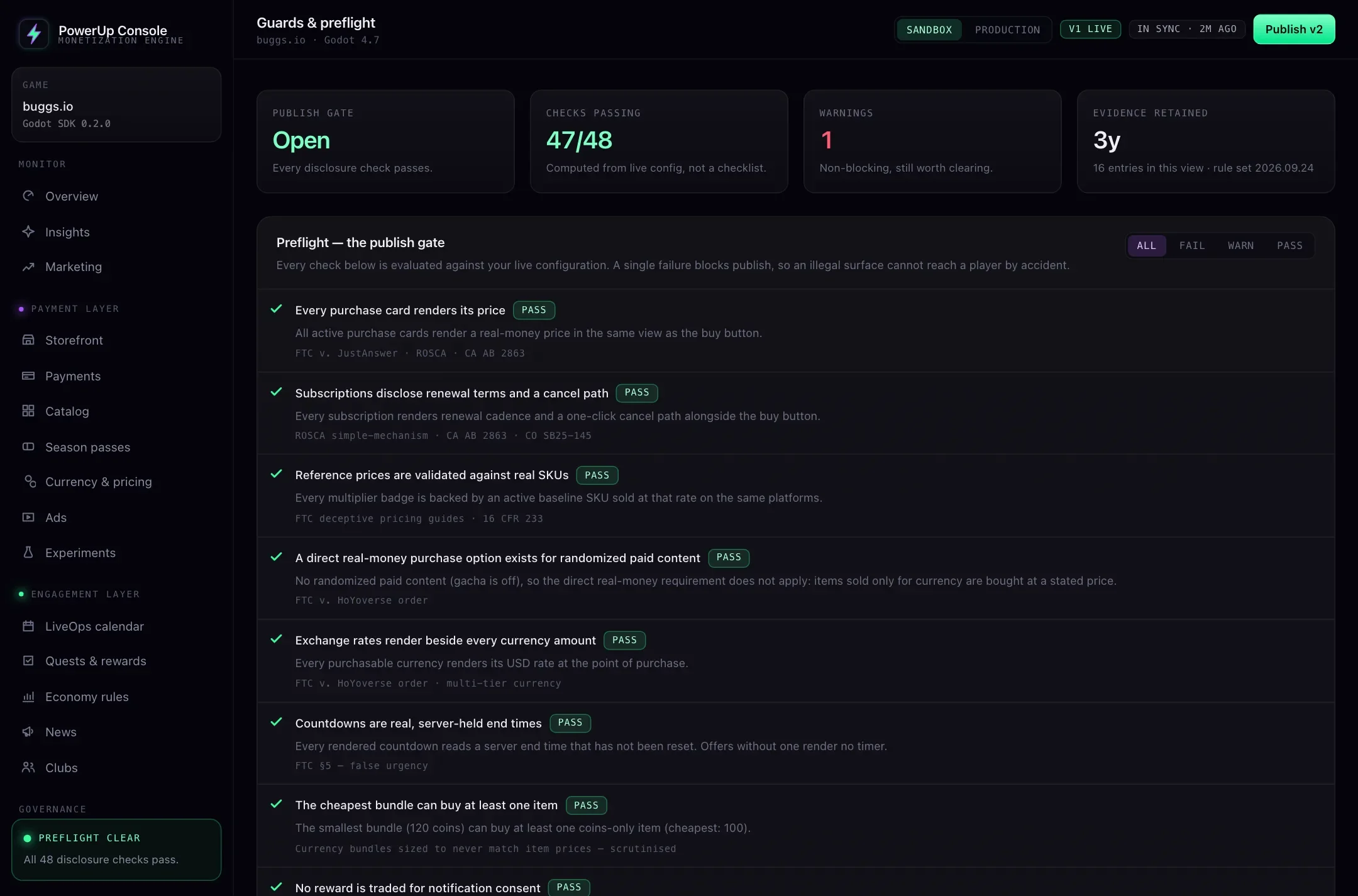
- Checks before you publish. Changes wait in a draft, and publishing runs 48 automated checks. Coin prices have to show their real-money price too, "best value" badges have to be true, countdowns need a real end date, store product ids are checked, and test ads can't slip into a production release. If a check fails, nothing ships, and you can roll back any release. The store rules pages go into what they're based on.
- Guards in the SDK. The price and terms rules also run in the addon (
PowerUpDisclosure). If your store draws offers withPowerUpOfferButtonor thePowerUpStorefrontnode, it can't show a multiplier badge the server never verified, run a countdown for an offer with no end time, or enable a buy button without a price.
What web checkout looks like in Godot
On web and desktop, PowerUp opens a Stripe Checkout from the game. Browsers block a popup that opens after
an await, so you create the checkout when the product sheet opens and open it the moment the player taps
pay:
var _checkout: Dictionary = {}

func _on_product_sheet_opened(sku_key: String) -> void:
    _checkout = await PowerUp.start_checkout(sku_key)   # create it while the sheet opens

func _on_pay_pressed() -> void:
    # Open it right away. After an await, the browser would block the popup.
    if _checkout.get("ok", false) and not PowerUp.open_checkout(_checkout.checkout):
        %ContinueInThisTab.show()   # its button: start a "redirect" checkout (see the Stripe guide)
On phones the same product goes through create_purchase_intent(), the store's own sheet, then
submit_receipt(). Web checkout for Godot covers the whole flow.
Fees, side by side
As of October 2026, Xsolla's pricing pages, such as the one for its Buy Button, list 5% of transactions plus the cost of the channel, with no integration cost or upfront payment, and its SDK page says there's no monthly fee or minimum volume. Xsolla calls it one price for all of its products.
With PowerUp you pay Stripe, Apple and Google their usual fees, plus your PowerUp plan. On the web, Stripe's standard US card rate is 2.9% + 30¢ for domestic cards, and Managed Payments, which makes Stripe the merchant of record for digital products and handles tax in more than 80 countries, adds 3.5%. To see what moving some sales from the app stores to the web might be worth, try the web checkout fee calculator.
Already on Xsolla?
PowerUp has early connectors for Xsolla, Paddle, Lemon Squeezy and RevenueCat that record purchases made there by webhook. They don't let the game check out through those providers: in-game checkout is Stripe, the App Store and Google Play. If you sell through Xsolla today, ask us about the connector on a demo.
Other Xsolla alternatives for indie games
If you want what Xsolla does (a web store and a merchant of record) rather than an in-game engine, these are worth comparing too. Facts from their own sites, as of October 2026:
- Stripe Managed Payments. Stripe as the merchant of record for digital products, with Checkout and payment links, tax in 80+ countries, fraud and disputes handled. 3.5% on top of Stripe's processing fees.
- Paddle. A merchant of record with a page for games, at 5% + 50¢ per checkout transaction on its pay-as-you-go plan. For products under $10 it asks you to get in touch for bespoke pricing.
- Stash. A web shop, in-app payments, a launcher, loyalty and a merchant of record for games, with localized checkout and local entities in 100 countries, in its words. No price on its site.
Which should you pick?
- Pick Xsolla if you want a web shop players visit outside the game, the widest choice of payment methods, Xsolla as your merchant of record, or link-outs from your US mobile game.
- Pick PowerUp if your Godot game sells inside the game on web, mobile and desktop, and you want the store, coins, passes, quests and ads in one addon, with every change checked before it ships.
- Compare a merchant of record such as Stripe Managed Payments or Paddle if tax handling is the main thing you need. PowerUp works with Managed Payments on the web.