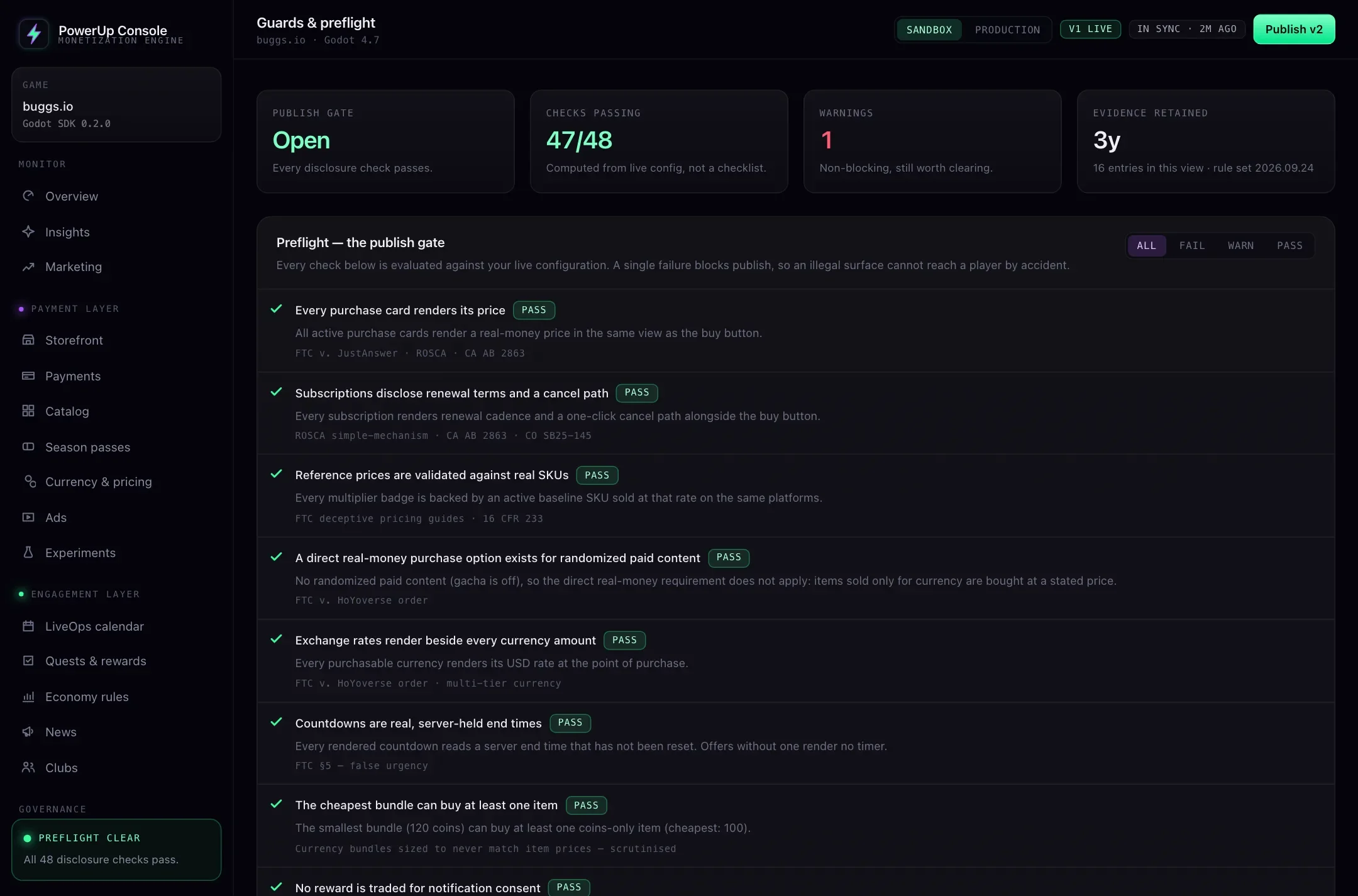
Game monetization compliance is mostly a list of small promises. The price is on the card. The countdown is real. The "best value" badge is true. Kids can't spend without limits. Each one is easy to break with a single config change, and you usually find out from a player, a store reviewer or a regulator. PowerUp checks them for you: every change in the console waits in a draft, and publishing runs 48 automated checks against your real setup first (49 when Stripe Managed Payments is on). If one fails, nothing ships.
How the publish gate works
- It reads your setup, not a questionnaire. The checks run on the exact prices, bundles, passes, ads and age settings you're about to publish.
- Fail blocks, warn doesn't. A failure stops the publish until you fix it, with no override. A warning shows in the report so you can decide.
- Each check names its source. Every result says where its rule comes from: a law, a case, a store rule, or PowerUp's own policy where no outside rule applies. You can read the rule yourself.
- Rollbacks are checked too. Going back to an older version runs the gate again before it goes live.
- The game follows the same rules. The Godot SDK won't turn a card without a price into a buy button, draws a countdown only from a server end time, and shows a value badge only when the server checked it. See remote config for drafts, versions and rollback.
What the checks protect
| Group | Checks | What it protects | What the checks cite |
|---|---|---|---|
| Prices and offers | 10 | Prices on every card, subscription terms and a way to cancel, honest value badges, real-money rates for coins, real countdowns, a cheapest coin bundle that can buy something, free offers that give something, one featured offer at a time, a cap on attention badges | FTC Act section 5, FTC v. JustAnswer, FTC v. HoYoverse, the FTC's pricing guides, ROSCA, California AB 2863, Colorado SB25-145, Apple guideline 3.1.2 |
| Game versions and items | 9 | Items players own stay usable, money never buys what's free or earned with XP, every locked item can be obtained, version rules that work | FTC Act section 5, your terms on owned items, internal policy |
| Ads | 6 | No Ads sold only where there are ads to remove, ad frequency floors, test ads kept out of production, AdMob rewards verified on the server, ad networks that can serve | FTC Act section 5, Google Play Families, Apple guideline 1.3, AdMob and AdSense policies |
| Season passes | 5 | Rewards that claim themselves or show their deadline when earned, seasons that don't overlap, a visible price for premium, real rewards, honest last-chance prompts | FTC Act section 5, FTC v. JustAnswer, ROSCA, age-appropriate design codes |
| Operations | 5 | Store product ids, a valid time zone, healthy integrations, a reviewed production launch, a warning when an experiment you've logged breaks its guardrail | App Store Connect and Google Play Console rules, operational, internal policy |
| Younger players | 4 | An age question before purchases and ads, parental consent and spending limits, no rewards for notification consent, no time-played quests for minors | COPPA, GDPR's rules for children, Google Play Families, age-appropriate design codes, Apple and Google developer terms |
| Quests and events | 3 | Paid event access says so on the button, quests and event ladders count real progress toward real rewards | FTC Act section 5, Apple guideline 3.1.1, internal policy |
| Random rewards and direct purchase | 2 | No randomized paid content, and a direct real-money option if there ever were | FTC v. HoYoverse, New York v. Valve |
| Fair play | 2 | Paid boosts kept out of ranked and away from minors, sensible daily caps on match rewards | Internal policy |
| Clubs and news | 2 | Tournament prizes and news gifts that exist, links that are secure | Consumer protection |
The citations lean American: the FTC, the federal subscription law ROSCA, a few state laws and COPPA, plus Apple's and Google's store rules. The only European reference is GDPR's rules for children, on the check that ads wait for the age question. No check cites the EU consumer authorities' principles on in-game currencies, though two of them enforce what those principles ask for. The pages below say exactly where the gate's coverage stops.
The rules in more detail
Each page below takes one area of law or store policy: what the rule says, with a link to the source and its status as of October 2026, what it means for an indie game in practice, and what PowerUp checks or leaves to you. For the player side of age and consent, see player accounts.