Two US states now build age checks and parental consent into the app store itself. The Texas App Store Accountability Act and Utah's app store age verification law make app stores verify each user's age and get a parent's consent before a minor downloads an app or makes an in-app purchase, and they give game developers duties of their own. This page covers what each law asks of a game, where each stands as of October 2026, and what PowerUp does and doesn't do about them.
The two laws at a glance
| Texas (SB 2420) | Utah (Code 13-76) | |
|---|---|---|
| Age categories | Under 13, 13 to 15, 16 to 17, 18 and over | The same four |
| Who verifies age | The app store | The app store |
| Parent's consent needed for | Each download, app purchase and in-app purchase by a minor | Downloading or buying an app, or an in-app purchase, by a minor |
| Developer duties | Rate the app and each purchase, tell stores about significant changes, check age and consent through the store's data | Check age and consent through the store's data, tell stores about significant changes, use the lowest known age for safety defaults |
| Enforcement | A deceptive trade practice under Texas consumer law | Lawsuits by harmed minors or their parents over the consent and data-sharing rules, at least $1,000 per violation |
| Status, October 2026 | Enforceable while the appeal continues | Duties start 6 May 2027 |
Texas: the App Store Accountability Act
Senate Bill 2420 was due to take effect on 1 January 2026. The app store has to verify each Texas user's age category, link a minor's account to a parent's account, and get the parent's consent for each download and each purchase. Blanket consent doesn't count. The store then tells developers each user's age category and whether consent was given, and tells them when a parent takes consent back.
What it asks of developers
- Rate the app and every purchase in it. Give each app store the age rating of the app and of each purchase that can be made through it, and the content behind each rating (section 121.052).
- Tell the stores before a significant change to your terms of service or privacy policy. The law counts changes to the data you collect, changes that affect the rating, new monetization, including "new opportunities to make a purchase" and new ads, and changes that materially alter how the app works or feels (section 121.053). How far that reaches for a live game that adds offers every week isn't settled. Ask your lawyer.
- Check age and consent using the store's data, with a system you run (section 121.054).
- Use that data only to enforce age rules, comply with the law and set safety defaults, and delete it once verification is done (section 121.055).
- Don't enforce a contract against a minor without consent, misrepresent ratings, or share the data (section 121.056). A developer who rated in good faith using widely adopted standards, or relied in good faith on the store's age and consent data, has a safe harbor.
Where it stands in court
- 23 December 2025. Judge Robert Pitman in the Western District of Texas blocked the law with a preliminary injunction in CCIA v. Paxton, finding it likely unconstitutional.
- 28 May and 4 June 2026. The Fifth Circuit paused the injunction, first briefly and then until the appeal is decided, which let the law take effect.
- 6 July 2026. The Supreme Court denied an application to lift that pause.
- As of October 2026, we found no decision on the appeal itself, so the law can be enforced unless a court rules otherwise.
The stores have moved. Apple says new Apple Accounts in Texas are subject to the law from 4 June 2026, and asks developers to use its Declared Age Range API, the Significant Change API in PermissionKit, a new age rating property in StoreKit, and App Store Server Notifications to learn when a parent withdraws consent. Google's Play Age Signals API returns age signals for eligible Texas users who created their accounts after 28 May 2026.
Utah: the App Store Accountability Act
Utah passed its law in 2025 and amended it in March 2026. The current text is in Utah Code Title 13, Chapter 76, and the 2026 amendment moved the duties for app stores and developers to 6 May 2027.
From that date, a developer has to (section 13-76-202):
- Check, through the app store's data sharing, each Utah account holder's age category and, for a minor, whether a parent consented.
- Ask for that data when someone downloads or buys the app, and when you make a significant change.
- Tell the stores about significant changes, meaning a material change to your terms of service or privacy policy that changes the data you collect, changes the age rating, or brings in-app purchases or ads to an app that had none.
- Start safety features and defaults from the lowest age category you have, from the store or your own data. Parents can adjust them for their child afterwards.
- Not enforce a contract or terms against a minor unless the store's data shows a parent consented, and not share the age data with anyone.
You may also ask the stores to keep minor accounts from downloading or buying your app at all.
Only a minor, or the parent of a minor, harmed by a violation can sue. A suit against a developer has to be about enforcing terms against a minor without consent, misrepresenting the parental consent information, or sharing age data. A parent who wins gets the greater of actual damages or $1,000 per violation, plus attorney fees and costs (section 13-76-401). A developer that relied in good faith on the store's age and consent data and followed section 202 isn't liable under the chapter.
What this means for a Godot game
Most of the work sits with Apple and Google. Yours is to listen to them and act on what they tell you:
- Read the store's age signal in your phone builds. Apple's Declared Age Range and Google's Play Age Signals are native APIs. Godot doesn't expose them, so you'll need a native plugin on each platform.
- Respect consent, including when it's withdrawn. In-app purchases go through the store's consent flow. When a parent revokes consent, the store tells you, and your game should stop treating that player as allowed.
- Tell the stores about significant changes, such as adding a shop or ads to a game that had none.
- Set defaults from the youngest age you know, and keep age data out of analytics and ads.
- Rate your game honestly, and in Texas each purchase in it too, in the way each store asks for.
What PowerUp does, and doesn't
| Area | PowerUp today |
|---|---|
| Age | A neutral birth-year question, asked once. The birth year isn't stored, only a band: child, teen or adult, worked out so it errs young. Until the age is known the player sees no ads, and once anything priced is on sale they can't buy. The 13 to 15 and 16 to 17 split in these laws isn't modelled. |
| Store age signals | Not integrated. Your support team can set or clear a player's band in the console. |
| Parental consent | Players in the child band can buy only when your support team has recorded a parent's consent in the console. Withdrawing it blocks purchases again and closes any web checkout the child still has open. It's per player, not per purchase, and separate from the store's consent. |
| Spending | A monthly limit for kids and teens, which publishing requires. Subscription charges count toward it. |
| Ads | No ads until the age is known, non-personalized ads for teens and child-directed ads for kids. |
| Rating and change notices | Not handled. The console's Releases page compares your draft with any published version field by field, which helps you spot a change worth reporting. |
| Publish checks | Two checks make sure the age question, consent rule and spending limit are set up before anything priced or any ad goes live. They cite COPPA, age-appropriate design codes, GDPR's rules for children, Google Play Families and Apple's and Google's terms. No check cites the Texas or Utah law. |
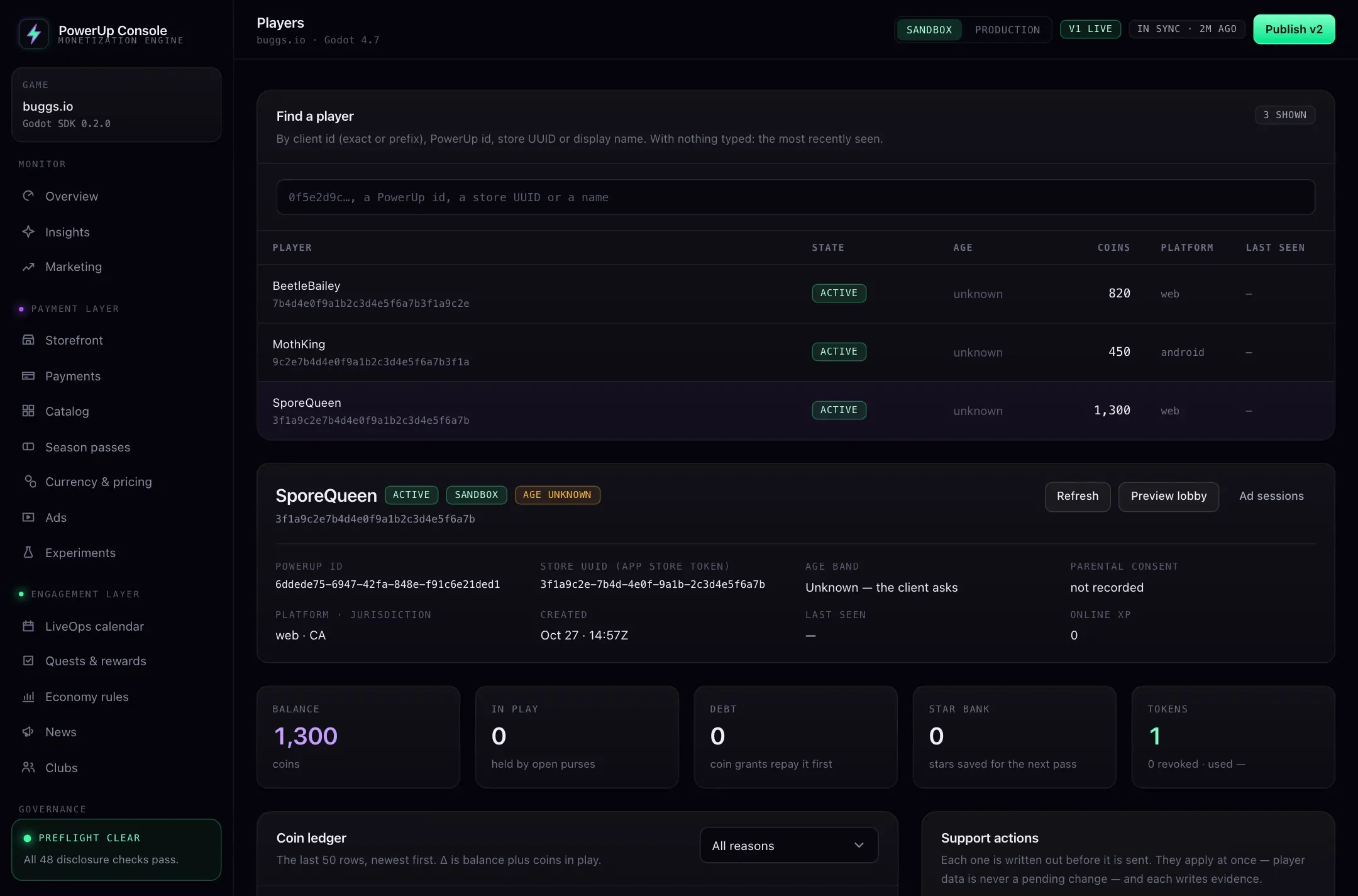
On phones in Texas (for the accounts the stores cover so far), and in Utah from May 2027, the store's consent flow sits in front of a minor's App Store and Google Play purchases, and PowerUp's age rules apply on top of it. On web and desktop builds, where players pay through Stripe and no app store is involved, the store's flow isn't there, so PowerUp's age question, consent rule and spending limit are the checks in place. The player accounts docs show the age question and consent in GDScript, and in-app purchases for Godot covers the store side.